The Biggest Wave in a Generation Is Coming for Aussie Sparkies. Will You Be Ready?
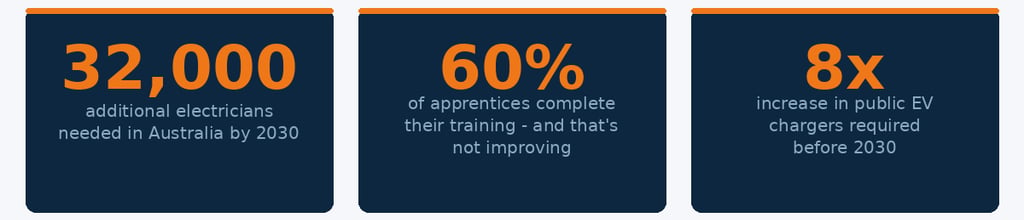
Australia needs 32,000 more electricians by 2030. EV charging, renewable energy, and housing construction are creating the biggest surge in electrical work in a generation. Here's why the sparkies who scale now will win - and how to start.
Matt Harding
4/12/20265 min read
Let me ask you something straight.
If more work than you could ever handle landed on your doorstep tomorrow - more than you could physically do, more than you could quote, more than you could schedule - would your business be able to catch it? Or would it slip through your fingers because you're the only one who can run the thing?
That's not a hypothetical. That's what's coming. And most electrical businesses in Australia are not set up to take advantage of it.
The numbers that should get your attention
The federal government's own modelling - from Jobs and Skills Australia - puts the shortfall at 32,000 electricians by 2030. Master Electricians Australia has been sounding the alarm. The Electrical Trades Union called it "literally unprecedented." The Clean Energy Council says electrical work will represent one third of all jobs growth in Australia by 2030.
One third of all jobs growth. In the entire country. Going to one trade.
And there aren't enough sparkies to do it.
Why the demand is real - and not going away
This isn't a short-term blip. It's a structural shift being driven by forces that have been building for years and are only now starting to bite at the same time.
The energy transition. Australia has committed to 82% renewable energy by 2030. That means solar farms, wind installations, battery storage, grid upgrades, and the rewiring of how the country generates and distributes power. All of it needs electricians. Most of the skilled workforce to deliver it doesn't exist yet.
EV charging infrastructure. Deloitte's analysis found Australia needs 27,500 new public EV chargers by 2033. That's eight new chargers installed every single day from now until then. Every charger needs an electrician. Every commercial building, car park, apartment block, and dealership that wants to be EV-ready needs electrical work done - and a lot of it. The EV charging market alone is projected to grow from $304 million today to nearly $1.7 billion by 2034.
Solar and battery installs. Homeowners and businesses are adding solar and battery storage at a rate that was almost unimaginable five years ago. The residential upgrade market isn't slowing. It's accelerating.
Housing construction. Australia's population is growing and the government has committed to hundreds of thousands of new homes. Every one of them needs wiring. The pipeline is enormous.
An ageing workforce retiring. Baby boomer electricians are leaving the trade in significant numbers. They're not being replaced fast enough. TAFE NSW froze its second-semester intake in 2024 because training capacity was maxed out. The pipeline of new tradespeople is running dry at exactly the moment demand is running hot.
"We are heading into literally unprecedented skills shortages in the electrical trades. Left unchecked, these skills shortages risk our electrical licensing regime - and they're emerging as a real handbrake on the pace of what we can build."
- Michael Wright, Electrical Trades Union National Secretary
So what's the problem?
If you're a sparky, you might be reading this and thinking: great, more work. And you'd be right - in theory.
But here's the thing that nobody talks about.
More work doesn't automatically mean more money, more freedom, or a better business. Not if your business is still built around you doing every job yourself. Not if you're the one quoting every job at 9pm after being on the tools all day. Not if one sick day or one bad month sends the whole thing sideways.
The sparkies who will genuinely benefit from what's coming aren't the ones who work the hardest. They're the ones whose businesses are structured to actually capture the demand. That means a team you trust. Systems that work without you. A pricing model that makes money, not just turnover. A business that can say yes to the right jobs and no to the wrong ones - and not collapse either way.
The wave is coming whether you're ready for it or not. The question is whether it lifts you up or wipes you out.
The window is narrower than you think - but it's still open
2030 is four years away. That sounds like a long time. It isn't - not if you're starting from scratch on building a real business.
But here's what people get wrong: you don't need years of preparation to put yourself in a completely different position. You need twelve months of deliberate action. Make your first proper hire. Work out your real numbers. Pick the niche you want to be known for. Start getting off the tools one day a week. That's it. That's the whole plan to start with.
Twelve months from now, a sparky who's done those four things is operating a fundamentally different business from one who hasn't. Different enough to take on contracts they couldn't have touched before. Different enough to actually capture some of what's coming.
The window isn't closed. But it's not wide open forever either.
The biggest risk for Aussie electricians right now isn't a lack of work. It's not being ready when the work arrives.
What the ones who'll win are doing differently
They're not necessarily smarter or better at the trade. In most cases, they've just worked out a few things earlier.
They know their real numbers - what it actually costs to send a sparky to site, what margin they need to make a job worth taking, and what their charge-out rate needs to be for the business to be sustainable. They're not guessing.
They've made their first hire - and they've figured out how to delegate properly, not just hand off tasks and hover. They know that a good employee eventually gives them time back rather than just adding to their workload.
They've identified their niche - the type of work they're going to be known for, so they're not competing on price with every other sparky in the suburb. Commercial solar. EV charging. Strata. High-end residential. They've picked something and they're building a reputation in it.
And they've started getting off the tools - not completely, not all at once, but enough to spend real time on the business rather than in it.
None of this is complicated. But it does require someone to actually explain how.
Sources
Jobs and Skills Australia / Powering Skills Organisation - electrician workforce modelling
Master Electricians Australia - workforce shortage response, 2024
Electrical Trades Union - Michael Wright, national workforce statement
Clean Energy Council - Jobs Report, clean energy workforce forecast
Deloitte Australia - EV Charging Infrastructure: The Next Frontier, 2024
IMARC Group - Australia EV Charging Market Report, 2025
Gemcell - Understanding the electrician skills shortage in Australia, Nov 2025